


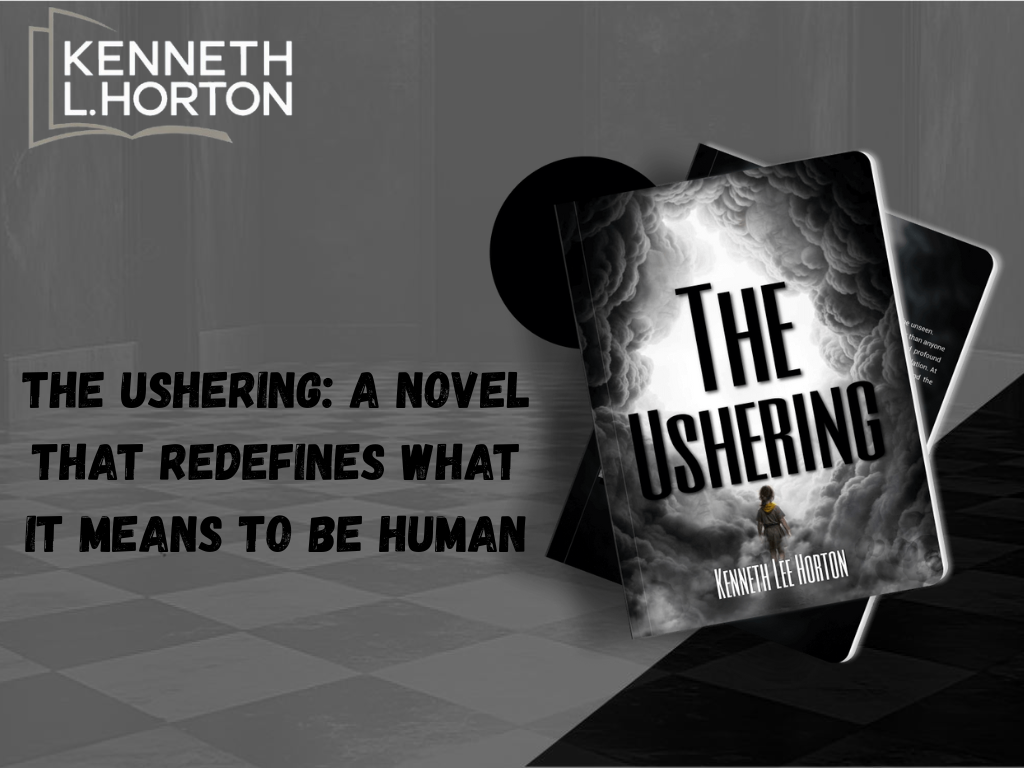
Every once in a generation, a novel arrives that refuses to stay confined within the expectations of genre. It stretches beyond entertainment and into something deeper—an awakening, a provocation, a guided mirror turned toward the human soul. The Ushering is one of those rare books. Kenneth Lee Horton weaves speculative fiction, historical richness, and spiritual inquiry into a narrative that feels simultaneously intimate and cosmic. The story is bold, unapologetic, and quietly revolutionary.
From its opening pages, The Ushering positions itself far from traditional dystopian or metaphysical fiction. Horton reaches back billions of years, reminding us that humanity is the youngest character on Earth’s stage—and perhaps the most arrogant. The introduction lays the groundwork for the book’s central question: If humanity has evolved this far, what or who might we one day evolve into? And more importantly, what forces—spiritual, psychological, or transcendent—will guide that transformation?
Yet the beauty of The Ushering lies not in its philosophical breadth but in its characters. Horton builds his story around individuals who feel startlingly real, flawed, hopeful, and touched by destiny. They are not chosen in the fantasy-novel sense; they are chosen by circumstance, mystery, and sometimes by forces they can’t explain.
One of the earliest characters we meet is Cassandra “Cass” Ha Joon Conway—a child whose life is altered during an ordinary trip to a Chicago park. When she wanders away from her Brownie troop, drawn by a force she cannot articulate, she encounters an elderly vagrant sitting alone on a beach. Their meeting is strange, tender, and otherworldly. Horton writes the scene not as a weird type of spectacle but with the quiet intimacy of spiritual revelation. The moment feels lived-in, weighty, and real.
Cass’s encounter becomes a seed that does not fully bloom until much later. Horton understands the power of patience; he lets his characters grow, collide, and ripple across each other’s lives in ways that feel like destiny disguised as coincidence.
Then there is Peter “Doc” Daugherty, one of the book’s most unforgettable presences. A World War II Marine with a moral center forged in fire and loss, Doc has survived not only war but the emotional consequences of it. Horton builds Doc with the careful attention of a biographer—shaped by heritage, battle, humor, philosophy, and the spiritual experiences he cannot quite explain. His wartime encounter with Lt. John Davis becomes a pivot point not only for the man he becomes but for the generations that follow.
Matthew Davis, John’s grandson, is another cornerstone of the story. A child of uncanny perception and unsettling potential, Matthew is raised by the Daugherty’s in an environment that blends discipline, compassion, and mystical guidance. Horton’s storytelling shines brightest when exploring the relationship between this boy and the two people responsible for shaping him. Their connection feels like mentorship, parenthood, destiny, and cosmic design all intertwined.
And then there is the wider world—the governments, the institutions, and the shadowed power structures that sense something shifting long before the rest of humanity does. Horton builds a political layer beneath the spiritual one: secret programs, hidden agendas, and global leaders who suspect that evolution is no longer a biological process but a metaphysical one.
What sets The Ushering apart from other speculative novels is the way Horton refuses to pit science against spirituality. Instead, he binds them together. Evolution meets consciousness. Physics meets telepathy. War meets inner awakening. Characters face not only the battles outside but the ones within themselves—fear, ego, hope, and identity. The result is a narrative that asks readers to consider their own place in the grand design of existence.
This is not a book to be skimmed. It invites readers to slow down, absorb, and contemplate. The pages are filled with meditations on good and evil, destiny, love, and the mysterious nature of human potential. Horton’s writing is cinematic yet intimate, philosophical yet grounded in real emotion.
Most importantly, The Ushering offers something that modern fiction often forgets to give: hope. Hope that humanity can evolve—not technologically, but spiritually. Hope that the next chapter of our story may not be our end, but our beginning. Hope that in a world saturated with noise, chaos, and fear, there are still individuals whose existence matters more than they realize.
The message at the heart of the novel is simple yet profound:
Believe deeply in something.
Because belief—real, grounded belief—is the spark that ignites human evolution.
With The Ushering, Kenneth Lee Horton has created more than a novel. He has created an invitation to imagine, to question, and to awaken. For readers who crave stories that linger long after the final page, this is a book that belongs in your hands and in your thoughts.