


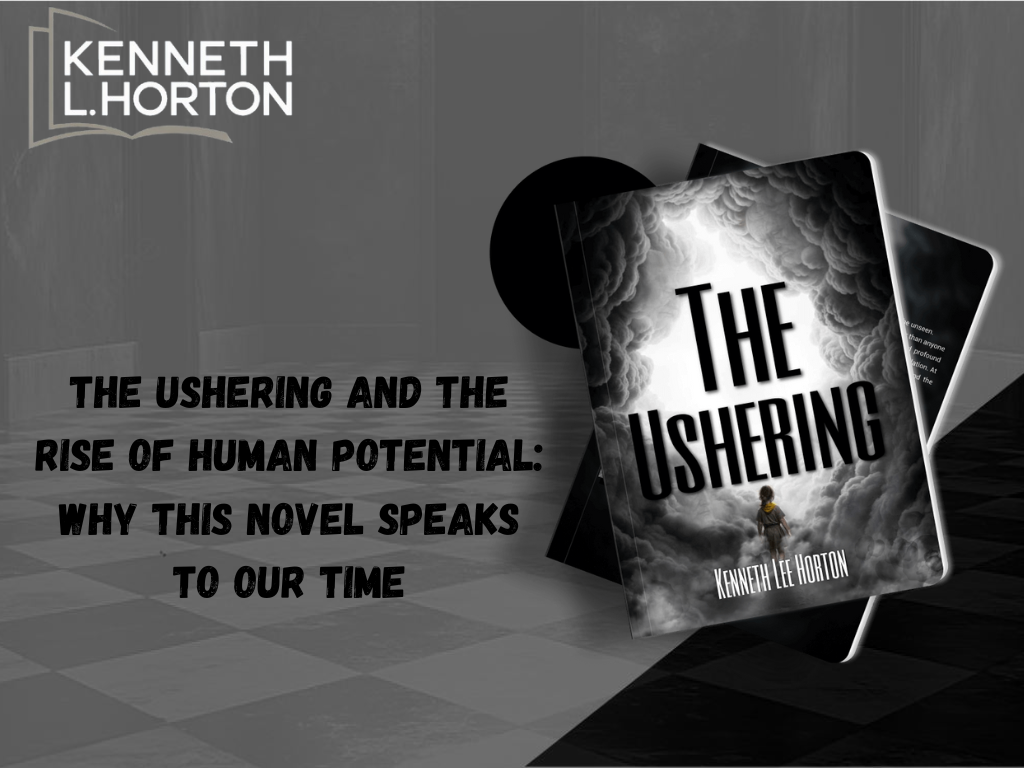
Some novels entertain. Some challenge. A rare few arrive at precisely the moment the world needs them. Kenneth Lee Horton The Ushering belongs in that final category. It is not simply a work of speculative fiction—it is a book about transformation, awakening, and the unseen evolution already unfolding within and around us. In a decade defined by uncertainty, polarization, and existential questioning, Horton offers something rare: a story that dares to believe in humanity again.
What immediately distinguishes The Ushering is its foundational premise—that human evolution is not finished, and that our greatest transformation will not be physical, but spiritual and psychological. Horton invites readers to consider the possibility that certain individuals throughout history have appeared ahead of their time because they quite literally were. They carried unusual insight, strength, empathy, or intuition. They were anomalies—quiet hints of what humanity could one day become.
Horton builds his narrative on this idea, but he never slips into the abstract. The story feels real because it is anchored in characters whose struggles reflect our own. Their journeys illuminate the book’s deeper message: human evolution is not simply a scientific process but a moral, emotional, and spiritual one.
Among the novel’s most compelling arcs is the life of Peter “Doc” Daugherty. His story embodies the very essence of the book—transformation through adversity. Horton crafts Doc with the kind of authenticity rarely found in modern fiction. A Marine hardened by war yet softened by compassion, Doc is both contradictory and deeply relatable. His time on the blood-soaked island of Iwo Jima is described with harrowing detail, but there is beauty in the brutality. It is in this crucible that Doc experiences a moment of transcendence—one that alters the trajectory of his life and, years later, the lives of those he would guide.
What makes Doc exceptional is not that he possesses some form of power; it is that he possesses extraordinary humanity. He does not fear death. He does not hate his enemies. He chooses empathy in situations designed to erase it. Horton writes him as a bridge between the world that is and the world that could be—a living embodiment of human potential.
That potential becomes central again when Matthew Davis enters the story. Matthew, the grandson of Doc’s wartime friend, is a child who seems to carry within him echoes of something ancient, intuitive, and deeply mysterious. Horton’s portrayal of Matthew is sensitive and layered. The boy is not depicted as a spectacle or a prodigy in the traditional sense. Instead, readers witness the quiet turbulence inside him—the moments of calm, the flashes of anger, the eerie inner clarity that adults cannot explain.
Matthew’s upbringing in the Daugherty household becomes one of the most emotionally resonant aspects of the book. Horton beautifully captures the intimacy of their makeshift family—the peaceful rhythms of rural life, the unspoken lessons passed from mentor to student, and the profound love that shapes the boy’s development. In an era dominated by noise, technology, and haste, these passages feel like a refuge.
But The Ushering does not unfold in isolation. Horton expands the story’s scope to include governments, military leaders, and secretive institutions who are beginning to sense the same truth: a shift in human consciousness is underway. He introduces characters like Admiral Becker, Captain Bunn, and the brilliant Tobias Hanson—individuals operating at the edges of power, intelligence, and scientific discovery. Their worlds intersect with the novel’s more intimate storylines in ways that feel inevitable. Horton reveals that personal evolution and global transformation are not separate forces—they are reflections of each other.
Running parallel to these narratives is the unforgettable opening experience of Cassandra “Cass” Conway. Her childhood encounter on a quiet Chicago beach is one of the novel’s most powerful scenes. Horton writes it with evocative detail, allowing readers to sense the strange calm, the undefinable pull, and the spiritual significance of her meeting with the elderly vagrant who becomes her guide into a hidden dimension of existence. Cass’s story blossoms later in the book, but even in its early moments, it hints at a destiny that will shape the course of humanity.
What ties all these threads together is Horton’s masterful handling of good and evil. He challenges the simplistic notion that people are born inherently one or the other. Instead, he proposes something far more interesting: that evil is taught—that darkness is a distortion of potential rather than an innate truth. And if someone can descend into pure malevolence, then somewhere else, someone must rise into pure goodness. The universe, Horton suggests, seeks balance.
It is this moral architecture that makes The Ushering so relevant today. We live in an age filled with questions about identity, purpose, human capability, and the future of our species. Many feel that humanity is standing at a crossroads, uncertain of which direction to take. Horton acknowledges that anxiety—but he responds to it with hope.
His message is clear:
We are more than what we currently understand about ourselves.
We are capable of more than we imagine.
And the next chapter of our evolution begins not with machines, but with us.
The Ushering is not just a novel—it is an experience. It leaves readers with a lingering sense of possibility, a quiet stirring that maybe, just maybe, destiny is not something distant. It is something alive within each of us, waiting to be recognized.