


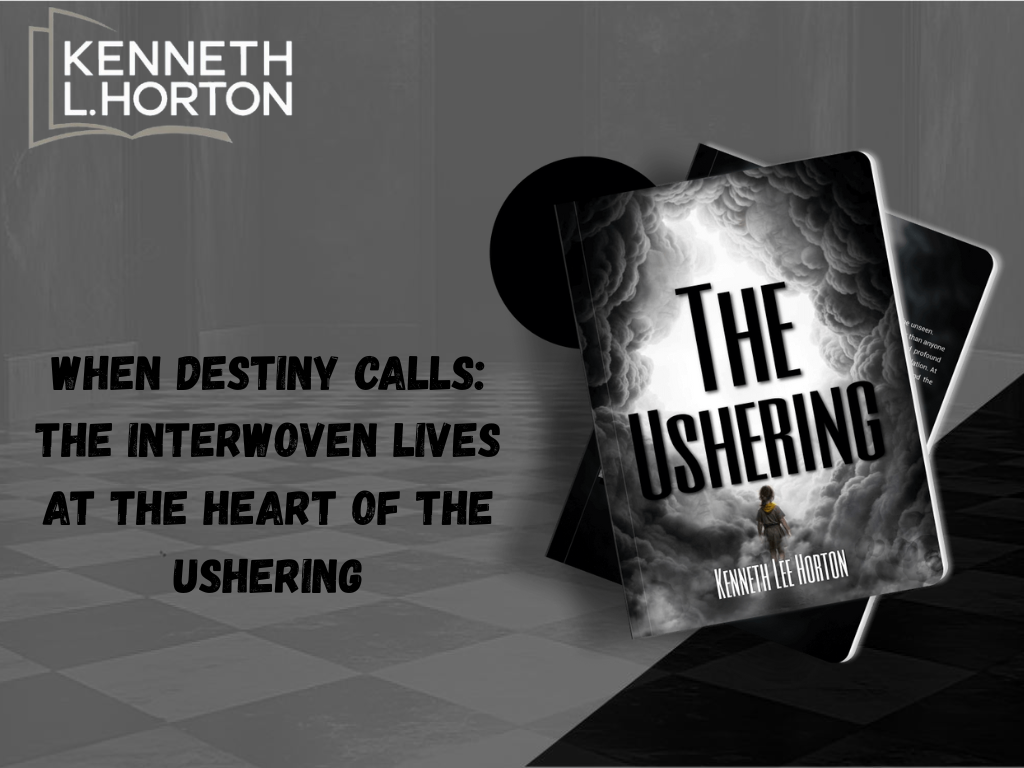
Some novels capture the imagination; others capture something far more elusive—the soul. The Ushering by Kenneth Lee Horton is a story built on intertwining destinies, where every character, every moment, and every decision feels connected by an invisible thread. It is a book that understands a simple truth: no life exists in isolation, and no journey toward transformation happens alone.
As a work of speculative fiction, The Ushering steps boldly into themes of human evolution, spiritual elevation, and metaphysical potential. But it’s true strength lies in the way it treats human connection as the driving force of destiny. The book unfolds through a mosaic of characters, each carrying pieces of a puzzle they do not yet comprehend. Their individual stories—stunning on their own—merge into a shared path that leads toward something larger than themselves.
One of the most compelling threads in this tapestry is the relationship between Peter “Doc” Daugherty and Matthew Davis.
That encounter becomes the seed of Matthew’s future. When John Davis nears the end of his life, he makes a final request: that his grandson be raised and mentored by the same man who once carried him, half-dead, off a battlefield. It is a request wrapped not in sentimentality, but in trust—trust in the man he believes Matthew is destined to become. Peter accepts without hesitation, sensing something extraordinary in the boy even before they meet.
Matthew himself is a wonder of a character. Horton doesn’t paint him as a prodigy for spectacle’s sake; instead, Matthew’s gifts feel rooted in something old, mysterious, and deeply human. He is perceptive in ways that unsettle the adults around him. He experiences moments of anger that seem too intense for a child. And he harbors an inner world that feels both ancient and newborn. When he arrives at the Daugherty home, the family dynamic shifts—not through conflict, but through a quiet reshaping of purpose. Peter becomes his mentor. Jody becomes his anchor. Together, they create a fragile but beautiful sanctuary where the boy can grow into the destiny that seems to follow him like a shadow.
Yet Matthew is not the only character touched by fate. Cassandra “Cass” Conway, whose childhood encounter with a mysterious elderly man changes the trajectory of her life, carries her own thread of cosmic significance. Horton writes Cass with the perfect balance of innocence and depth. Her experiences are not merely strange—they are transformative. She becomes a symbol of awakening: a child who sees the world not only as it is, but as it could be. Though her story begins quietly on a Chicago beach, its echoes travel across continents and generations.
What makes The Ushering so compelling is its refusal to treat destiny as a rigid script. Horton’s characters do not march toward predetermined futures—they wrestle, question, resist, and eventually embrace the paths laid before them. Destiny, in this book, feels like a conversation rather than a command. The universe calls, but its chosen individuals must decide whether to answer.
And answering is never simple.
The book expands its scope beyond individual lives to examine how institutions, governments, and hidden organizations respond when whispers of human evolution begin to surface. Horton incorporates global politics with a deft hand—never overshadowing the emotional core of the story, but adding layers of intrigue that enrich it. Intelligence agencies, spiritual communities, and scientific minds all sense the same truth: something is unfolding that cannot be controlled, only understood.
Through these interconnected storylines, The Ushering offers a profound meditation on good and evil.
But The Ushering is not a philosophical text pretending to be a story. It is, above all else, deeply human. Horton’s characters bleed, laugh, grieve, and love. They face the same fears that readers carry—the fear of loss, the fear of insignificance, the fear that destiny is something that happens to us rather than something we create. And through their journeys, Horton offers a different vision: destiny is not a chain, but an invitation—one that leads toward a higher expression of what humanity might become.
In an era where fiction often leans toward cynicism, The Ushering stands firmly as a novel of wonder. It celebrates the potential hidden within every individual. It reminds us that evolution isn’t just biological—it is emotional, spiritual, and communal. And above all, it affirms that even in a fractured world, human connection remains the foundation of everything.
This is a book for readers who crave depth. For those who want a story that lingers. For anyone who suspects that humanity’s next great leap will not come from machines or technology, but from the awakening of the human spirit.
With The Ushering, Horton hasn’t just written a novel—he has crafted a legacy of hope.